

What Is a Political Debate? Types, Rules, and Key Examples

A political debate is a formal and structured opportunity for opposing candidates or representatives to discuss and present arguments for and against policy issues in front of an audience. Debaters are governed by rules of engagement which limit their speaking times and designate who or what to address when making their points. The goal is to inform voters and test each candidate’s grasp of public policy.
What Is a Political Debate?
Most people have watched a political debate. Fewer understand the mechanics behind it.
A political debate is a formal, structured process in which two or more candidates or political representatives argue opposing positions on issues of public concern. Political debates are not casual discussions. Rather, they occur within a specified structure, with a moderator and an audience, and they have many rules and time limits. Within the structure, participants form arguments and respond to challenges.
In political discussions, the term “debate” does not merely mean to argue. The structure is formed to give voters the chance to see different policy ideas, as well as to see which candidates can think well and fast when under pressure, and to see the candidate’s individual position on the variety of subjects. Political debates are a part of every level of democratic elections, including the school board elections and presidential elections.
The Commission on Presidential Debates (CPD) is a private, non-partisan organization that is responsible for the debates held during the Presidential elections in the United States. According to the CPD, their main focus is that “general election debates are held every four years between and among the leading candidates for the offices of President and Vice President of the United States.” (CPD, debates.org)That framing captures the central logic: political debates exist to serve the electorate, not the candidates.
Why Political Debates Matter
Voter education does not happen automatically. Most citizens do not read policy white papers or track legislative records in detail.
Political debates compress that information gap. They put candidates on the same stage, under the same conditions, answering questions on the same issues — and they do it in front of audiences that no other political format reliably reaches. From 1988 to 2020, CPD-sponsored presidential debates attracted audiences of between approximately 35 million and 100 million viewers, according to Nielsen Media Research. The first 2020 presidential debate drew 73.1 million domestic viewers.
Research backs up the educational function. A 2017 study by University of Pennsylvania researchers Kenneth Winneg and Kathleen Hall Jamieson, published in the American Behavioral Scientist, found that debate watchers gained measurable knowledge about candidates’ policy positions after viewing the 2016 presidential debates — even when their opinions of the candidates themselves did not shift. The knowledge gain was real. The persuasion effect was limited.
That is an important distinction. Political debates are better understood as civic education tools than as vote-switching mechanisms. They create an informed baseline. What voters do with that information is their own decision.
The Purpose of Political Debates
Political debates serve four overlapping purposes:
- Voter education. Candidates explain their positions on public policy directly to the electorate. Viewers gain side-by-side comparisons they cannot get from campaign ads or party websites.
- Accountability. Candidates face questions they did not prepare in advance. Moderators and opponents can push back on vague or contradictory answers.
- Civic engagement. High-viewership debates pull non-regular voters into the political process. In 2016, around six-in-ten voters said presidential debates were very or somewhat helpful in deciding which candidate to support, according to Pew Research Center data cited by the CPD.
- Democratic legitimacy. Debates give smaller-party candidates a path to national visibility — provided they meet participation thresholds — and reduce the information asymmetry between well-funded and lesser-known campaigns.
Types of Political Debates
Political debate is not a single format. The type of debate depends on the electoral level, the country’s political system, and the organizing body.
Presidential Debates
Presidential debates are the most-watched form of election debate in the United States. They feature the major-party nominees for president and, separately, for vice president. The CPD has organized 33 general election presidential debates since 1988. Candidates must meet strict nonpartisan criteria to participate, including appearing on enough state ballots to have a mathematical path to 270 electoral votes and demonstrating at least 15% support in major national polls.
The format has evolved. Early CPD debates used a moderator and a panel of journalists. By 1992, the town hall format — in which undecided citizen voters ask the questions — was introduced. A seated-table format debuted in 2000. In 2012, 2016, and 2020, debates were organized around six 15-minute thematic segments to encourage deeper policy discussion.
Parliamentary Debates
Parliamentary debates take place inside legislative chambers rather than on a campaign stage. Members of both parliament and congress will argue for or against the suggested legislation, budgets, and motions. The rules for a parliamentary debate state that speakers must address the chair and not each other, that each speaker follow the strict order, and that each speaker ways within their allotted time. An example of organized communication in a legislature is the, ‘Question Time’ that is a component of the British Parliament where the Prime Minister is asked direct questions by the opposition MPs.
Local Election Debates
Local election debates follow many of the same structural rules as presidential debates but operate at the level of mayoral races, city council elections, school board contests, and state legislative campaigns. The audiences are smaller, the topics are more granular, and the format is often organized by local civic groups, newspapers, or public broadcasters. These debates tend to be more accessible for first-time candidates and can directly influence voters in tight local races where name recognition is lower.
Student Political Debates
Student political debates simulate formal election or legislative debates in academic settings. Formats include Model United Nations, mock parliamentary debates, and Lincoln-Douglas-style competitive debate. These styles instruct pupils to investigate policy stances, develop arguments that are organized, respond to opposing views, and do all this in a timely manner. Skills such as verbal communication, and reasoning, as well as the use of evidence, are the skills needed for active civic involvement as an adult.
Key Elements of a Political Debate
While various political debate formats exist, there are the same basic elements:
- Participants: Candidates or people debating a given political issue/product.
- Third-party participant: Often called a moderator, this person will remain neutral and will time the participants, ask the questions, and will not support any candidates or make any political statements.
- A format. An agreed structure specifying speaking time, the order of responses, and whether cross-examination or rebuttals are permitted.
- Rules: An agreed structure outlining the rules for debating, such as time constraints and the order of who speaks, and if there is an opportunity for a rebuttal or cross-examination.
- Topics: This will include questions and other debate stimulus items that include the broad political debate and public concerns such as economic debate, foreign political relationships, health care, immigration and security debates, etc.
- Time constraints. Enforced limits prevent candidates from monopolizing speaking time or avoiding questions through prolonged non-answers.
Rules of Political Debates
Debate rules vary by organization, format, and electoral level — but several principles appear consistently across formats.
Common debate rules include:
- Equal speaking time. Everyone has an equal opportunity to make their opening statement. They must all respond to questions in the same amount of time.
- No interruptions. Generally, candidates will not be allowed to interrupt one another when given the opportunity to speak. Enforcement of this rule varies.
- Moderator authority. The moderator controls the floor. Candidates who violate rules (ignoring time limits, speaking over others) can be formally warned.
- Question transparency or sealed delivery. In most high-stakes debates, neither the candidates nor the organizing body sees the specific questions in advance. CPD moderators select their own questions and do not share them with campaigns beforehand.
- Audience conduct rules. Since a live audience can influence how at-home audience members respond, one of the typical rules is not allowing them to clap, cheer, or make any noises in response to anything.
- Candidate selection criteria. For presidential debates, participation eligibility is determined by the CPD’s nonpartisan criteria, including ballot access in sufficient states and 15% polling support.
These rules exist to protect the format’s integrity. Without them, a political debate collapses into a shouting match — which is more entertainment than civic education.
How a Political Debate Works
Understanding the mechanics helps viewers evaluate what they are watching rather than reacting purely to optics.
Before the debate:
- The organizing body selects dates, venues, and a moderator weeks or months in advance.
- Candidates can RSVP to the offer and work out the specifics of the setup.
- The moderators work out the setup of question rounds without any sort of help or involvement from candidates or any of the organizing bodies.
During the debate:
- Candidates give their opening statements.
- The questions posed by the moderator are all focused on policy.
- Candidates must respond within the time that has been set for them. This is usually between one and two minutes.
- This is followed by rebuttals or some sort of cross-examination, which depends on how the question round has been set up.
- The event is wrapped up by the closing statements.
After the debate:
- How the media and critics phrase their coverage of the event shapes how the general public sees the candidates and their performance.
- The work of Winneg and Jamieson (2017) shows that those who watch the post-event coverage of the event and the news, retain significantly more knowledge of policy than those who watch the event by itself. How the media phrases the coverage of post-event news is significant.
Political Debate vs. Political Discussion
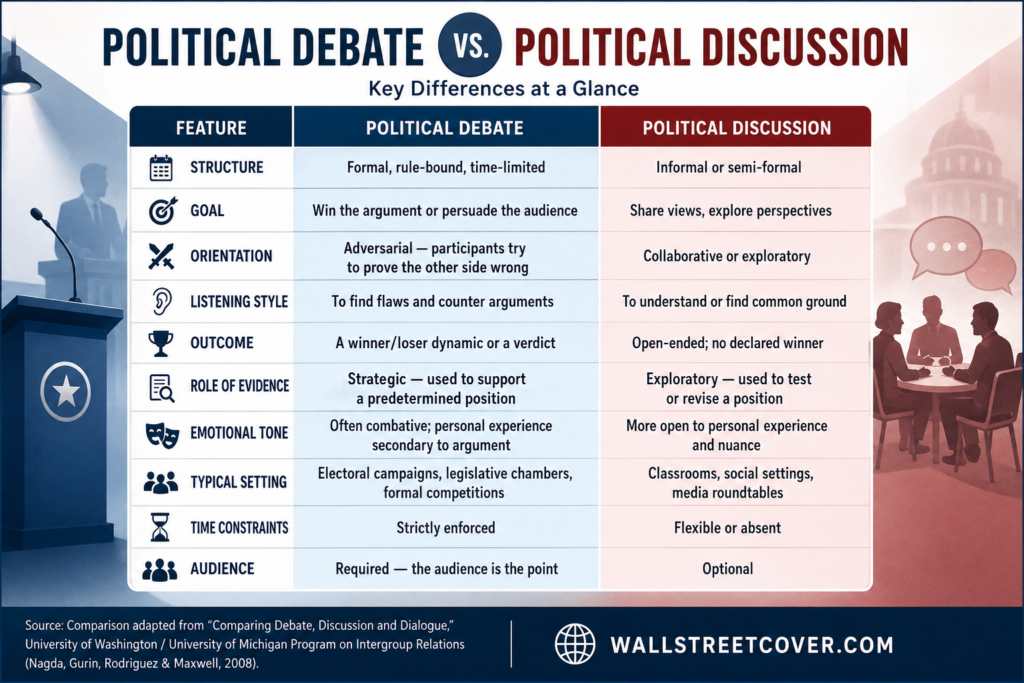
These two forms of political communication are often used interchangeably. They are not the same.
| Feature | Political Debate | Political Discussion |
| Structure | Formal, rule-bound, time-limited | Informal or semi-formal |
| Goal | Win the argument or persuade the audience | Share views, explore perspectives |
| Orientation | Adversarial — participants try to prove the other side wrong | Collaborative or exploratory |
| Listening style | To find flaws and counter arguments | To understand or find common ground |
| Outcome | A winner/loser dynamic or a verdict | Open-ended; no declared winner |
| Role of evidence | Strategic — used to support a predetermined position | Exploratory — used to test or revise a position |
| Emotional tone | Often combative; personal experience secondary to argument | More open to personal experience and nuance |
| Typical setting | Electoral campaigns, legislative chambers, formal competitions | Classrooms, social settings, media roundtables |
| Time constraints | Strictly enforced | Flexible or absent |
| Audience | Required — the audience is the point | Optional |
Source: Comparison adapted from “Comparing Debate, Discussion and Dialogue,” University of Washington / University of Michigan Program on Intergroup Relations (Nagda, Gurin, Rodriguez & Maxwell, 2008).
The practical implication: a political debate is designed to produce a clear, public argument. A political discussion is designed to explore. Treating one as the other leads to frustration. Expecting a presidential debate to produce nuanced consensus is the wrong frame. It is not built for that purpose.
Advantages of Political Debates
1. Direct comparison at scale.
Debates put all major candidates in the same format simultaneously. Voters can evaluate communication style, policy knowledge, and judgment without consulting multiple separate interviews or events.
2. Exposure for lesser-known candidates.
Primary debates in particular help voters become familiar with candidates outside the frontrunner. McKinney and Warner (2013), reviewing 22 academic studies in Argumentation and Advocacy, found that nearly 60% of viewers changed their candidate preference after watching presidential primary debates — compared with very low persuasion rates in general election debates.
3. Policy knowledge transfer.
Even when debates do not shift candidate preferences, they educate. The 2017 Winneg and Jamieson research confirmed that watching a debate increases viewer knowledge about where candidates stand on specific policy issues — a baseline that supports more informed voting.
4. Accountability without a script.
Candidates have full control over their campaign speeches and ads. Contrarily, debates test their ability to think and respond to the unexpected in the moment. This adds the element of real pressure and shows how candidates respond in those situations.
5. Broad civic reach.
No other single political event attracts tens of millions of simultaneous viewers. Debates function as a shared civic moment in a fragmented media environment.
Disadvantages of Political Debates
1. Minimal effect on general election vote choice.
The most rigorous research finding in this area is sobering. Le Pennec and Pons (2023) examined 62 elections and 56 televised debates across 10 countries over 60 years. They concluded that televised debates had almost no statistically significant effect on voters’ decisions in general elections, even among voters who watched the debates. (The Quarterly Journal of Economics, 2023) While that may still show that debates can influence voters, it questions the validity of the assumption that debates can determine the outcome of elections.
2. Style over substance.
Voters can be more likely to make judgments about a candidate’s debate performance through the candidate’s (and opponent’s) apparent charisma, confidence and physical presence, rather than the substance or accuracy of their policies. While a candidate’s (or their opponent’s) debate performance may be substantially deficient, their aggressive nonverbal behavior (e.g., gestures, facial expressions, interruptions, etc.) can still influence viewers’ perceptions. Nonverbal aggression in debates generally is considered a “backfire” for candidates who are losing; however, it still shows that style can be more important than substance.
3. Format constraints compress complexity.
Debate formats do not allow candidates to be sufficiently or adequately comprehensive in their policy responses. Rather, they are forced to be simple and memorable.
4. Gatekeeping can exclude viable candidates.
The CPD’s 15% polling threshold is meant to structure the debates around leading candidates, but effectively excludes independent and other 3rd party candidates. This can be especially damaging when other candidates have significant levels of support even if they do not meet the above threshold.
5. Preexisting beliefs are hard to shift.
Candidate preferences are most heavily shaped by party and personal beliefs and the information candidates promote through media. Research has and continues to show that debates are more effective at reinforcing beliefs than they are at changing them.
Famous Political Debate Examples
The Lincoln-Douglas Debates (1858)
Seven debates held across Illinois between Abraham Lincoln (Republican) and Stephen A. Douglas (Democrat) during the 1858 U.S. Senate campaign. The central topic was the expansion of slavery into new U.S. territories. These debates set a standard for substantive, extended political argumentation and remain among the most analyzed examples of political communication in American history.
The Kennedy-Nixon Debate (1960)
Senator John F. Kennedy and Vice President Richard Nixon had their first televised Presidential debate on September 26, 1960. 70 million people (about 2/3 of the adult population in the US at that time) witnessed this debate. population at the time, according to the JFK Library. The debate is widely studied for how television changed political communication: radio listeners rated Nixon’s performance more favorably, while television viewers favored Kennedy. It established visual presentation as a permanent factor in political debate evaluation.
Reagan-Mondale Debates (1984)
President Ronald Reagan’s performance in his first 1984 debate against Walter Mondale raised questions about Reagan’s age and sharpness. Reagan’s rebound in the second debate — including his well-documented one-liner deflecting the age question — is frequently cited in research on how incumbents recover from first-debate underperformance. McKinney and Warner (2013) specifically reference Reagan’s 1984 recovery as a pattern that repeated with George W. Bush in 2004 and Barack Obama in 2012.
Clinton-Trump (2016)
The first 2016 debate between Hillary Clinton and Donald Trump set a viewership record of 84 million — the highest in U.S. debate history, according to Nielsen Media Research. It also represented the most-studied modern example of aggressive debate communication, with researchers documenting thousands of distinct instances of verbal and nonverbal aggression across the 2016 primary and general election debates.
Common Misconceptions About Political Debates
“Debates decide elections.”
The research does not support this. Le Pennec and Pons (2023) found no statistically significant effect on vote choice across 62 elections and five decades of data. Debates inform. They rarely convert.
“The most aggressive candidate wins.”
Montez and Brubaker (2019) found that nonverbal aggression specifically tends to backfire. Candidates who rely heavily on gestures, interruptions, and personal attacks often lose viewer approval rather than gain it — particularly when they are already trailing in polls.
“Debates are objective.”
Format choices — question selection, speaking order, time limits, moderator identity — all shape outcomes. Every structural decision creates conditions that may advantage one candidate over another, even when each element is selected in good faith.
“A political debate is the same as a political discussion.”
It is not. A debate is adversarial by design. Its goal is to win an argument or persuade an audience. A political discussion operates on collaborative or exploratory logic. Conflating them produces the wrong expectations for both.
“Debate watchers change their minds.”
Most do not — at least not on candidate preference. Winneg and Jamieson (2017) found no meaningful shift in candidate assessments before and after the 2016 presidential debates, even though policy knowledge increased. Minds open to information; preferences are stickier.
Frequently Asked Questions
What is a political debate in simple terms?
A political debate is a structured, rule-based exchange in which candidates or political representatives argue opposing positions on public issues before an audience. It has a moderator, defined speaking times, and a format agreed upon in advance. Its primary purpose is voter education and democratic accountability.
What is the difference between a political debate and a political discussion?
A political debate is formal, adversarial, and structured — the goal is to win an argument or persuade an audience. A political discussion is more informal and exploratory — the goal is to share perspectives or build understanding. Debates have moderators, time limits, and rules; discussions typically do not.
Why are political debates important in a democracy?
Political debates serve democracy by giving voters a direct, simultaneous comparison of candidates’ policy positions. They function as a civic education tool, increase political engagement, and hold candidates accountable in a format they cannot fully script in advance.
How do presidential debate participants get selected?
In the United States, the Commission on Presidential Debates applies nonpartisan criteria: candidates must be constitutionally eligible to serve as president, appear on enough state ballots to have a mathematical path to 270 Electoral College votes, and demonstrate at least 15% support in five major national polls. No candidate receives an automatic invitation.
Do political debates actually change how people vote?
Research suggests the effect on general election vote choice is minimal. A 2023 study in The Quarterly Journal of Economics analyzing 62 elections and 56 televised debates found no significant impact on voter decisions. However, primary debates show stronger effects — with research indicating nearly 60% of viewers changed candidate preferences after watching primary debates.
What are the main types of political debates?
The main types are presidential or executive debates, parliamentary debates within legislative chambers, local election debates at the city or district level, and student or academic political debates organized for civic education purposes.
What rules apply to most political debates?
Common rules include equal speaking time for all participants, no interruptions during an opponent’s allotted time, moderator authority over the floor, sealed or moderator-selected questions not shared with campaigns in advance, and audience conduct restrictions to limit crowd influence.
Who moderates political debates?
Moderators are typically experienced broadcast journalists or public figures selected for their familiarity with the candidates and issues, their live television experience, and their commitment to keeping the focus on the candidates rather than on themselves. In U.S. presidential debates, the CPD selects moderators several weeks before the event, and moderators choose their own questions without input from the campaigns or the CPD.
How long is a typical presidential debate?
U.S. presidential debates typically run 90 minutes. Recent CPD formats have divided that time into six thematic 15-minute segments. Individual response times are usually capped at one to two minutes, with shorter rebuttal windows.
What is the oldest political debate in American history?
The Lincoln-Douglas debates of 1858, held across seven Illinois locations during the U.S. Senate campaign, are among the oldest and most historically significant political debates in American history. They focused on the expansion of slavery and helped establish the model of substantive, extended candidate debate that later formats drew from.
Political Debates Are a Tool — Use Them as One
Political debates are not infallible. They reward style alongside substance, compress complex policy into tight time windows, and tend to confirm existing voter preferences more than they shift them. That is the research finding, and it is worth accepting.
None of that makes debates useless. What they do reliably — expose voters to policy positions, create moments of genuine accountability, and reach audiences no other format consistently matches — matters for democratic function. The Kennedy-Nixon debate pulled 70 million viewers into a shared civic moment in 1960. The 2016 Clinton-Trump debate drew 84 million. Those numbers reflect something real about the role Political Debate plays in public life.
The smarter way to use a political debate is to treat it as one data point, not a verdict. Watch for how candidates handle pressure, where they are specific versus evasive, and how their stated positions compare to their records. Then use the knowledge gained — Winneg and Jamieson (2017) confirmed it does transfer — to inform decisions made elsewhere.
A political debate is a structured argument designed for public benefit. What the public does with it is the part that actually determines outcomes.


