

7 Powerful Government and Public Administration Principles

Introduction
All countries and nations are organized on the basis of governance or public administration to maintain a more orderly, just, lawful & efficient state. Effective government institutions establish laws, last enforcement of public order and the provision of basic services as well as handling financial costs while supporting economic growth. Peace and rights will remain elusive, while education, health care, transportation and public safety – key to national development –will be severely underfed without effective government and public administration. Societies always develop, and therefore the Governments and administrative systems forever have to change according to peoples desires. Having knowledge about government and public administration makes citizens aware of how decisions are taken, what structure is used for judicious allocation of resources.
What Is the Study of Government and Public Administration?
Government and public administration is the subfield of political science that deals with the institutions, organizations, and processes involved in governing a nation or territory (also referred to as “public policy”). In addition, government creates laws to govern behaviour of citizens and norms for society. Public administration is concerned with implementation of those policies through government agencies and departments, as well as public organizations. Elected officials make the laws and set national priorities, but it is public administrators who implement those decisions. Government and public administration provide the basic framework of functioning countries, ensuring citizens’ access to better quality public services along with transparency, accountability, rule of law.
Gov and Public Admin Significance
Government and public administration are vital areas because of their role in nearly all facets of everyday life. Government institutions influence daily life—from issuing ID cards to the upkeep of roads, from public hospital management and school support to regulation for businesses or environmental protection. Robust administrative systems pave the way for a government to respond rapidly during urgent situations, create better economic opportunities and fight poverty in addition to ensuring equitable access to basic services. Well-governed and efficiently administered countries are usually more politically stable, economically successful, and exhibit higher levels of public trust in national institutions. Good governance also stimulates local and foreign investment, which creates jobs and provides a foundation for long-term growth.
The government is the best state as an institution of public administration.
Government and public administration are often intertwined, yet they serve different functions. The administration is about making those decisions come to fruition through practical application, whereas government primarily has the role of leadership and policy-making with legislators working directly within governmental jurisdictions. This is the dynamic that enables elected leaders to set national priorities while career administrators manage delivery through multiple departments and agencies. Successful government and public administration is a function of solid collaboration between elected officials and career civil servants. Effective communication and coordination translate into more efficient policy implementation, better management of public resources and improved citizen services.
The Key Functions of state and Public administration
A core function of government and public administration deals with keeping the peace. Laws are drafted by governments as a tool of protecting citizens, promoting public health and welfare, supporting sustainable development or guaranteeing national peace. These laws are enforced through police departments, courts and regulatory agencies.
Providing public services is another major role of state and administration. Public administration is required and needs to be very efficient for all including education, health care, transport, sanitation, emergency service etc serving citizens in a beneficial manner.
Governments also formulate economic policies that facilitate investment, job creation and financial stability. The government & public administration help the country grow sustainably while also addressing socio-economic challenges through proper resource utilization and planning.
The Structure of Government
To prevent an undue concentration of power, the governments in most democratic countries are divided into executive, legislative and judicial branches. The executive branch which oversee the daily business of government and also implements national policy through ministries (ministries) or administrative departments. The branch that has the power to write laws, approve budgets and represent citizens in decisions. The courts rule on laws, decide disputes and uphold constitutional protections. Each of these branches collaborates alongside one another to create a balanced system in which each institution plays a distinct role but contributes towards the effective functioning of government and public administration. The separation of powers bolsters democracy and keeps public institutions accountable.
Public Administration as A Profession
In the last several years, government and public administration has developed into a recognized academic discipline with standards of practice. Across the world, some universities offer a specialised course to teach students about public service careers such as policy analysis, financial management urban planning and public leadership. Public administration careers embody knowledge of law, economics and political science as well as management and organizational leadership. They should also have good communication, analytical and problem-solving skills to be able for dealing with complex public issues. As nations and governments increasingly use technology to harness the power of information, skilled administrators play a key role in making government and public administration more effective.
The Role of Civil Servants
While politicians come and go, civil servants are the backbone of government and public administration. They generally continue to 2 gamingfads.com hold their job after elections unlike elected officials who make it out of power and keep government services running seamlessly.
They are responsible for carrying out public policy, preparing budgets, managing government programs and personnel, as well as ensuring compliance with laws and regulations. Their experience as well as commitment to continuity can keep the government and public administration working smoothly, despite changes in leadership.
Public Policy and Decision-Making
Public policy can be termed as the backbone of government and public administration, essentially dictating how governments engage with national challenges and what the public requires. Identifying needs of government in relation to social, economic or environmental problems are the first steps when making policy. And so officials listen, survey scientists, blend solutions and set out policies they believe will advance the common good. Once approved, these policies need to be run through government agencies held accountable for progress and results. Good policy making relies on credibility, planning and public participation. Good governance and public administration consists of policy making, implementation, transparency in decision-making process to serve the citizens better with measurable improvement outcomes.
Financial Management in Government
Managing public finances is one of the most important responsibilities of government and public administration. Governments collect revenue through taxes, customs duties, and service fees to fund public programs and national development. Budget planning requires balancing national priorities while using public resources responsibly.
Administrators allocate funds to healthcare, education, transportation, defense, environmental protection, and social welfare. Transparent financial management reduces waste, strengthens public trust, and ensures government and public administration use public funds efficiently to support sustainable development.
Digital Transformation in Government
The field of government and public administration has been fundamentally reshaped by advances in technology that have enabled the automation, streamlining, measurement and comparison, tracking works output-based goals for performance management. Digital government services enable people to renew licenses, pay taxes, register businesses and apply for permits—or check public information—without going to a government office. They cut down on administrative costs whilst making services more convenient and accessible through online platforms. Governments are increasingly adopting artificial intelligence cloud computing and big data analytics for better decision making and service delivery optimization. In our technology-driven world, digital innovation is continuing to advance and Government/Public Administration will become more reactive with citizens while connecting governments with the people.
Transparency and Accountability
Sufficient transparency and accountability are the cornerstones of good government, public administration systems. In return, citizens expect greater insight into decision-making processes and the expenditure of public funds. Transparency:• Transparent institutions make available annual reports on finances, publications of regulatory documents and also bidding processes alongside data related to the performance outcomes that allow citizens an opportunity to assess government functioning. With accountability, public officials remain accountable for their actions and respond to bias or corruption. The result is strengthened governance and public administration through independent audit institutions, enhanced external oversight mechanisms, along with openness to input from the general population. Public trust and confidence in democratic institutions are strengthened when governments act openly and responsibly.
Public Administration: Human Resource Management
Since people is the greatest resource of government and public administration, human resources management is critical to effectively manage these governmental and non-governmental organizations. Government agencies spend taxpayer money to recruit qualified personnel, train them professionally, measure their performance and grow future leaders. Continuous learning helps public servants keep up with fast-paced technological changes, changing government regulations and elevated citizen expectations. Inevitably, leadership development programs ready administrators to lead complex organizations while providing a structure of ethics and innovation. Because skilled personnel leads to increased effectiveness and quality of governance, public administration can be performed in a way that access citizens reliably receive professional auxiliary services provided by the state.
There are a range of policy challenges facing Government and Public Administration
Howevercritical to public administration, the government has modern day challenges. Governments are forced to find quick solutions due to fast-paced population growth, urbanization, climate change and economic uncertainty along with technological change. Corruption is still an issue as it lowers public trust and blunts the power of government institutions.
This lack of financial resources presents a challenge as well. Governments are under pressure to deliver on the growing expectations of their constituents with increasingly constrained budgets. These institutions can accelerate socioeconomic growth, and by promoting transparency – managing resources efficiently while encouraging innovation; government in a manner that encourages them to serve the public better whilst ensuring accountability and long-term viability.
Public Administration and Government Leadership
Leadership alone is one of the most critical factors driving successful government and public administration. The traits of a public leader must include integrity, vision, communication skills and the capacity for sound decision-making under pressure They deal with motivation among employees, managing change and ensuring organizational objectives are met in public institutions. Great leaders push for inter-departmental cooperation, foster innovation and live by the values they promote in both word and deed. They also earn public trust by listening attentively to citizens and taking action on publicly expressed concerns. With growing complexity of governments, leadership development has emerged as a critical investment to enhance government and public administration capacities and longer term institutional performance.
Moral Conduct in Public Service
Ethics are an essential part of the government and public administration because people expect its officials to serve society with honesty, fairnessTransparency & Integrity: Transparency in Government– It enables citizens direct access key institutions that contribute toward a strong democracy. Leaders that are ethical public servants, staying away from any conflict of interest and protecting confidential information by returning items to the private sector if they become decision makers in a benefit for them through their positions.
Governments encourage ethical behavior via codes of conduct, training programs and independence oversight. Robust ethics standards mitigate corruption and bolster public confidence in government and the administrations that support it, engendering greater trust in institutions of governance.
Citizen Participation and Public Engagement
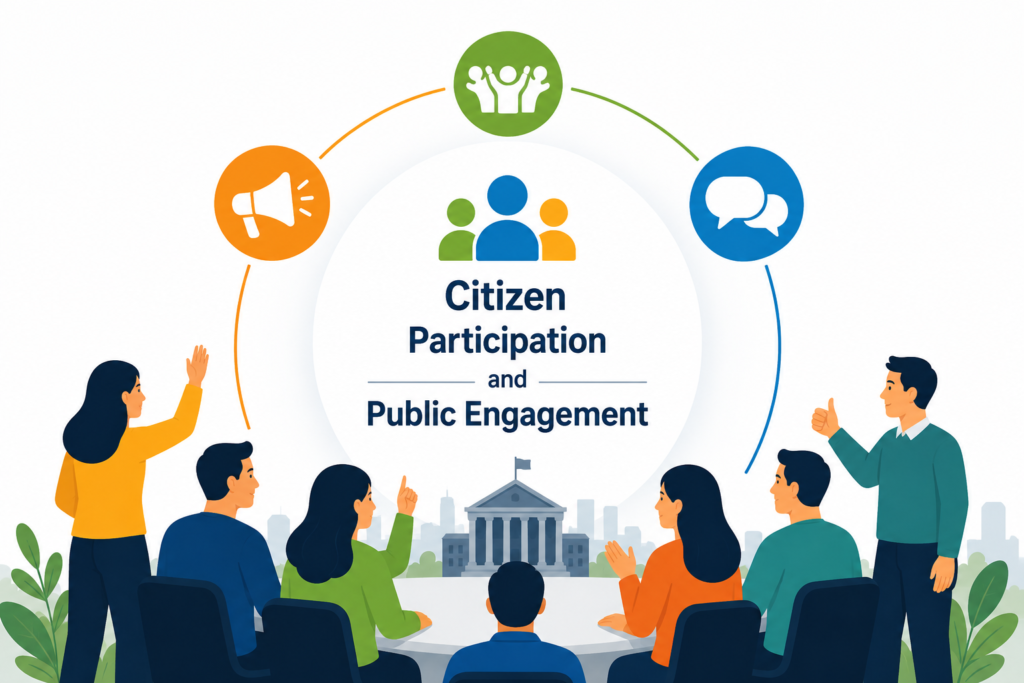
Modern government and public administration recognize that citizens should participate in public policymaking. Public engagement helps governments understand community needs, gather feedback, and create policies that better serve society.
Governments encourage participation through public consultations, community meetings, surveys, online platforms, and open forums. When citizens are involved, government and public administration become more transparent, accountable, and effective while strengthening democratic governance.
How Technology and AI Will Change Your Role
Technology is reshaping government and public administration through increased efficiency, accuracy, and service delivery. AI, automation, cloud computing and data analytics are together bringing quicker processing of information to aid meaningful decision-making in governments. Digitalisation allows to cut down the paperwork, speed up processes and enhance communication with citizens.
Smart technologies and applications can also enable healthcare, transportation, infrastructure as well as public safety. Moreover, digital transformation in government and public administration has also to include cybersecurity (security), data privacy as well as the issue of digital inclusion so that citizens can benefit from secure and reliable services.
Crisis Management and Emergency Response
Governments in general and public administration institutions face the challenge of being put to the test through unexpected events such as natural disasters, epidemics/pandemics other/large scale health crises (e.g. The success of any response must be based on planning, competent staff next to an adequate level of co-ordination between national regional and local authorities.
They manage emergency services, deploy resources to affected places, restore vital public infrastructure and aid in recovery for the long term. Good governance and effective public administration save lives, mitigate economic loss, and strengthen national resilience in times of crisis.
Public Sector Reforms
Reforms aimed at enhancing the efficiency of government and public administrative institutions figure regularly on governments’ agendas worldwide. Public sector reforms aim to increase effectiveness, reduce red tape, improve transparency and service delivery. Governments have undertaken numerous initiatives to simplify administrative procedures, adopted digital services, decentralized decision-making structures and fortified performance-evaluation systems. Such reforms promote innovation without imposing excess administrative burdens. Reforms work if there is political will, skilled management and relentless follow-up in order to actually get the desired results. You are trained with data till October,2023 As public expectations change over time; this is an ongoing reform that is important for the quality of government and public administration.
International Cooperation in Public Administration
As countries face global challenges including climate change, international trade and economics, migration and refugees, cybersecurity threats like cyber-attacks and damage by advanced persistent threat attackers (APTs), as well as public health responses to pandemic flu outbreaks or other emerging diseases globally [3–11]. Modern day governance often requires the collaboration of government and public administration with International Organizations, neighbor nations as well development partners to tackle these common problems.
Without access to knowledge, best practices and resources shared among governments can enhance disaster response, environmental management or economic development. Learning from successful models around the world can both bolster government and public administration, as well ensure that solutions proven to work in other contexts are adapted to a situation relevant for each country.
Forthcoming Developments in Government and Public Administration
Technological innovation, demographic changes, environmental sustainability and rising public expectations will shape the future of government and public administration. Future government are projected to be more digital, data-driven and citizen-centered. Artificial intelligence (AI), blockchain technology, and advanced analytics will aid in enabling better decision making while also improving the delivery of services. Sustainable development goals will promote a challenge for the government to balance economic growth with environmental protection and social inclusion. To face ever more complex governance threats, future public administrators will need to possess high-level technical skills, strong leadership capabilities and ethical values. If context constrains innovation, government and public administration will be effective, responsive to changing needs but also innovative for others.
Building Public Trust
Both government and public administration cannot function successfully without the faith of the people. Trust in government institutions increases citizen compliance with laws and taxes, as well including engagement through civic behaviour. Trust is built through honesty, transparency, fairness and accountability in the provision of reliable public service delivery. The governments are able to reach the citizens via open communications, providing truthful data and answer clearly their concerns. Public confidence is also improved through strong oversight institutions, independent media, and vibrant civil society organizations. The best way to enhance democratic governance and promote national stability on the long run is for government and public administration to be guided by integrity, commitment towards serving the interests of citizens.
Conclusion
Only a strong and capable government can ensure the prosperity and success of any nation. They enforce the law, deliver public services, manage resources effectively and promote national development. Good governance depends on good leadership and accountable public servants, transparent institutions and responsible financial management.
Governments have to innovate along with society but still be open and effective. Effective government and public administration are vital for the delivery of effective public services, an engine for economic growth and innovation, a facilitator of improved social justice outcomes, key to building more resilient societies that promote equality before law while enabling each citizen to realise their full potential.


