

Role of Project Management Tools and Techniques in Completing the Projects Successfully

Introduction
Today, Project Management Tools and Techniques is a crucial part of the functioning of modern work. Whether small, medium or large scale professionals use project management practices to ascertain that end projects are delivered in time and as per budgeted costs/execution plans. Whether an enterprise builds software, launches a marketing campaign, or erects a building, good project management is crucial to getting the desired results from that effort. Project management professionals deploy a mix of project management tools and techniques which allows them to plan, implement or execute the subject deliverables while monitoring and controlling all firm activities. Apart from increasing productivity, you will harness your capacity for communication, collaboration and decision-making by using these tools/techniques throughout the project lifecycle.
Understanding Project Management Tools
These are software applications and digital platforms that help project managers and team members organize tasks, manage resources, track progress, communicate etc. Before, when project managers worked heavily with spreadsheets, paper-based schedules and manual report systems. Nevertheless, as the number of projects has increased in complexity there have also evolved sophisticated tools to automate many project management functions. These tools provide a single location for your team to find everything related to the project: informational, status updates on individual tasks/projects and files that need to be shared (regardless of geographic proximity).
Modern Project Management Tools and Techniques changed the way organizations manage projects. This offers visibility into the current state of a project so that managers can see their projects in real time, identifying potential issues before they escalate. They also provide accountability by allowing you to track who is responsible for each task and how much work they have contributed. With Digital Transformation becoming increasingly adopted by businesses, project management software has proven to be instrumental in improving operational efficiency and increasing the chances of projects being delivered successfully.
Importance of Project Management Tools
Today, when the business environment is changing at a high pace project management tools cannot be overlooked. There are many team members, stakeholders, deadlines and resources involved in a project that coordination is always an uphill task. But trying to manage these pieces without fashion is what can cause confusion, missed deadlines, budget overruns and a dent in output. Project Management Tools and Techniques: These tools brings structure, organization and enables teams to work effectively while remaining aligned with the project.
Now one of the greatest benefits that project management tools offers is better communication. Within one platform, team members can effortlessly share all updates, discuss tasks and collaborate on documents. These abilities play a vital role in the successful execution of projects.
Popular Project Management Tools
There are a few project management tools that have grown in popularity across industries because they actually work and are very easy to use. For instance, Trello is widely recognized for its visual task management using boards, lists and cards to organize work. Where the visual workflow management is vital, it serves small teams and simple projects especially well.
AsanaAnother existing tool is Asana, a platform to organize your work in teams. The software provides capabilities like assignment of tasks, project timelines and progress monitoring. The simple, intuitive interface is one reason many organizations select Asana which allows teams to manage various project types in a flexible manner.
Microsoft Project — A more comprehensive tool in comparison to advance a project, is whitespace for elaborate projects. It consists of super scheduling, budgeting and resource management features. Microsoft Project is typically used by large organisations to keep track of larger, more complex projects with the requirement for in-depth planning and reporting.
Jira is a commonly appearing tool for software development teams. It facilitates Agile project management and offers sprint planning, issue tracking, workflow automation and other features. Similarly, Monday. For a while now, com has been recognized for its unique dashboards with customizable interface and levels of automation that support collaboration around any business process.
Role of Project Management Techniques
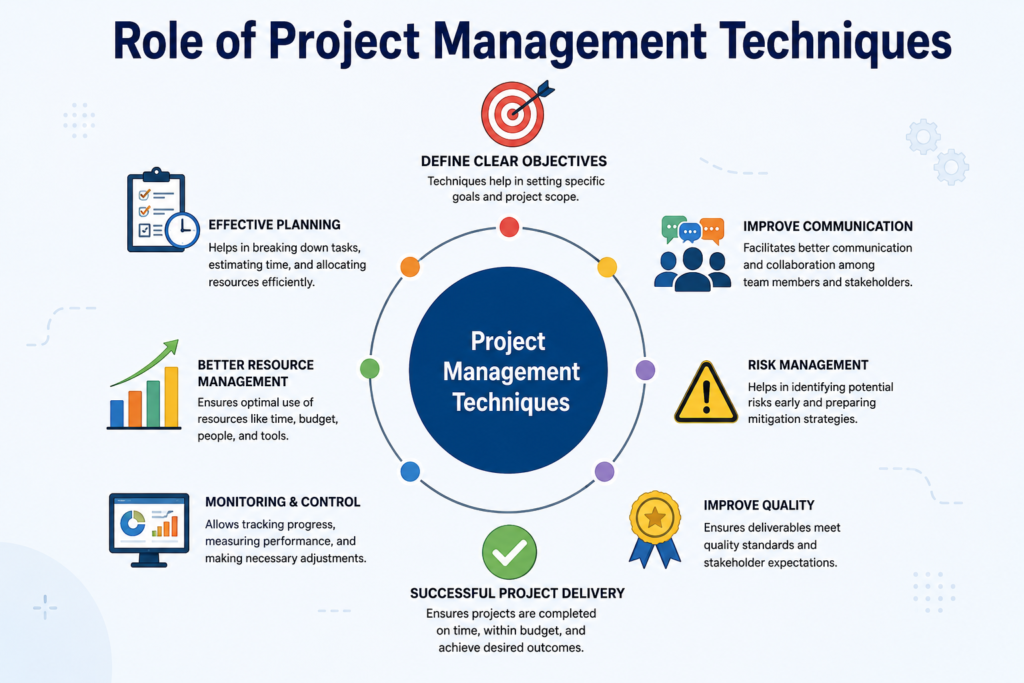
Where as Project Management Tools and Techniques tools lay the technological base for directing projects, techniques give a strategic framework that can be applied in order to get started on doing it right. Project management techniques are formalized methods that provide project managers with frameworks for planning, organizing and controlling aspects of a project. These techniques work to make sure projects stay on track for achieving their goals while reducing risk and improving efficiency.
Based on their scope, complexity or even demand from industry projects require different approaches to be managed. Choosing the right technique drives how teams work together, decide and respond to challenges over a project lifetime.
Work Breakdown Structure (WBS)
The Work Breakdown Structure (WBS) is one of the most fundamental techniques in project management. It breaks down a project into these smaller, manageable things called work packages. Digging a hole is easier if you are able to break that down into smaller steps, this same rationale holds true with project management; By decomposing your larger projects in the form of multiple tasks managers can more accurately estimate costs and resources allocated.
Work Breakdown Structure delineates how to execute the project. This provides team members with an understanding of their roles and managers can track the progress easily. WBS minimizes the complexity of your project by creating a simple visual hierarchy which makes it easy to understand and manage.
Gantt Charts
Gantt charts form some of the most popular Project Management Tools and Techniques for scheduling and tracking activities in projects. Gantt chart is a type of visual tasks representation along the timeline with start dates, end date and durations and task dependencies. This visual format assists project managers in quickly gaining an understanding of the schedule & identifying key milestones.
A big advantage of Gantt charts is that they can actually show potential timing issues and rescheduling. The managers can see in realtime that which activity is lagging, and they could take necessary decisions before it derails the overall project schedule. This allows Gantt charts to be a useful communication tool as well, making it easier for stakeholders to know where things are in the project.
Critical Path Method (CPM)
One of the popularly used Project Management Tools and Techniques to find out what tasks need to be done in sequence and how they influence time for completion of a project. Critical path: Activities that must be completed on time in order to avoid delaying the entire project.
Knowing which tasks are at a low level allows project managers to manage resources and focus on aspects of the project that can contribute most for success. This method aids to enhance scheduling accuracy, maximize resource use and minimize the chances of project delays. CPM works well for large and complicated projects that have interdependent tasks.
Agile Project Management
In recent years, Agile has quickly grown to become one of the most common project circumstantial methods- particularly in technology-driven industries like software development. Agile focuses on adaptability, interactions and continual enhancement Agile teams, therefore work in small increments or iterations as opposed to adhering to a strict project plan since their approach allows them the benefit of being agile by easily accommodating changes into requirements.
Among the most significant advantages of Agile is its customer-centric approach. Stakeholder involvement ensures regular constructive feedback that guarantees timely need-based deliverables with the utmost value. Agile also encourages collaborative work practices, transparency and ongoing learning making it an extremely powerful methodology in environments where a project can change course rapidly.
Scrum Framework
Scrum is an Agile framework that organizes work into short periods called sprints. A sprint usually takes between one and four weeks to deliver particular objectives regarding the project. A Scrum team maintains the required cadence with regularly scheduled meetings — daily standups, sprint planning sessions and a post-sprint event called the sprint review to ensure things are still on track.
Through teamwork, accountability and transparency the Scrum framework brings added productivity. Team members collaborate, to tackle challenges autonomously, share knowledge across roles and expertise levels while delivering sprint goals. This iterative approach allows organizations to achieve quality results while staying agile.
Kanban Technique
Another Agile-based approach, Kanban is essentially a visualized workflow to enhance efficiency. Trello utilizes a kanban board with several columns that represent stages of work, like “In progress,” and so on. Tasks advance across the board as they move through the workflow.
Kanban aims to just get the most out of one workflow. This process ensures that teams work at a steady pace and gradually improve their processes. Work of Work: Kanban is very useful for the teams that deal with continual tasks and need to be flexible in their management process.
Risk Management Techniques
Every project faces uncertainties that can impact its success. Risk management methodologies assist P.M.s to recognize, evaluate and preempt potential risks prior turning into serious issues. Managing risk is key to this, which means writing a list of risks, assessing their likelihood and seriousness and figuring out how you will respond if they happen.
Organizations can manage risks before they become an actual disruption to execution, thus better delivering higher quality and more stable projects. Risk management also conveys confidence to stakeholders in the knowledge that potential issues are tracked and managed over time.
Project Management Techniques: Things to Keep in Mind
Best practices are critical to implementing project management tools and techniques effectively. Which means that before any project begins the objectives of the projects should be clear so we know what are trying to achieve. Your project plan should detail task completion, timeline, budget and also resource needs. OutcomesRegular communication: You should be updating team members so that they stay up to date and aligned with your project goals.
Project Managers must focus on regular progress monitoring using dashboards, reports and performance indicators. This means too that they can identify problems early on and adjust if needed. The idea is to promote collaboration, accountability and a culture of continuous improvement that can take project time from great magnitude.
Conclusion
In today’s competitive business environment, project management tools and techniques play an important role in the successful completion of projects. Management tools: Trello, Asana, Microsoft Project, Jira and Monday. com — provide the technology to handle operations, resources and communication. In parallel, methods like Work Breakdown Structure, Gantt Charts (also see this article on Miro) Critical Path Method Agile Scrum Kanban and Risk Management offer structured ways to plan and execute developments.
Companies that spend on the right set of tools and techniques are in a better position to boost efficiency, minimize risks, improve collaboration and hit project targets. With the evolving nature of technology, Project Management Tools and Techniques practices will also get more advanced whereby businesses can start to manage projects are becoming much complex with utmost confidence and success rate.


