

Internal communication safe: The complete guide to protecting internal business communication

Introduction
Communication is essential to any organization that wants to execute on its mission. Everyday, employees e-mail, share secure records, attend meetings and do group projects. With the scale and complexity of cyber threats continuing to grow, organisations should ensure that these discussions are kept private, secure. Secure internal communication is one of the most essential priorities for an organization independent and size, and this just explains why.
Secure internal communication pertains to the approaches, mechanisms, and instruments that safeguard information within an organization. The authorization process guarantees that only those employees who should have access to sensitive data can. This protects against hackers and unauthorized users from disclosing information that could be valuable to your business by means of hacking, or accidental leaks such as loss of a USB key or unlocked machine.
From a company with ten employees to one with ten thousand, secure internal communication keeps information private and the team working together in trust. Companies that spend on solid communication security are better positioned to safeguard customer data, financial records, intellectual property and strategic plans.
In this guide, we analyze why secure internal communication is important, what are its advantages and the potential threats that could occur, and lastly offer solutions which can help organizations to increase their security in their workspace.
Why Secure Internal Communication Matters
Digital communications is an increasingly important part of modern business. Post-October 2023, employees exchanged emails, chatted over messaging applications, joined Zoom meetings and uploaded files to cloud storage. However, these activities can become targets for cybercriminals without secure internal communication.
Weak communication systems are often the starting point of data breaches. Organizations can fall victim to a series of exploits when attackers intercept messages, steal login credentials or deceive employees via phishing attacks. After penetrating a network, they are often able to read sensitive data and halt operations.
By implementing secure internal communication, organizations can shield themselves from these threats and build a safer digital workplace. With this, employees can work together without worry that their conversations will be intercepted.
Good communication security will also help you comply with privacy laws and industry regulations. In order to comply with legal stipulations and save themselves from hefty fines, many businesses have no choice but to protect customer data.
Importance of safe Providers of Internal Communication
Secure internal communication = the other side of cyber war, orgs will benefit much more than from it.
To begin with, it helps shield confidential information of the company. You have avoided unfreiebtigen access to financial reports, employ heuristics, customer data bases, contracts and other intellectual property.
Second, a secure internal communication boosts the sense of trust among the employees. Knowing that their conversations are protected makes workers feel safer sharing ideas and collaborating.
Third, secure communication mitigates the risk of costly data breaches. Avoiding even a single security incident can help spare the company dollars tens of thousands or even millions.
Another benefit is increased productivity. Employees do not need to spend half their time stressing over security and then can totally concentrate on their jobs.
Finally, effective internal communication enhances the image of an organization. Companies that can show cyber excellence are more likely to win the trust of customers and be chosen by business partners over their competitors.
Common Threats to Internal Communication
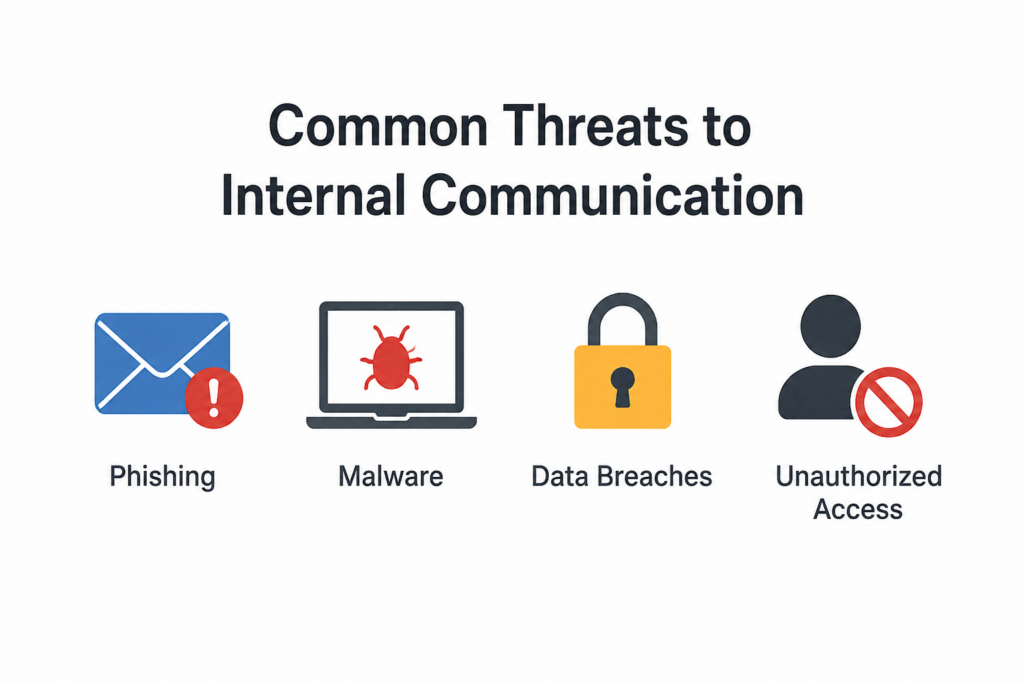
By identifying and understanding the risk, organizations can better craft security strategies. Unresolved threats can endanger secure internal communication features.
Phishing Attacks
Cybercriminals frequently send phony emails which are disguised as coming from a trusted entity. They can do this by either prompting employees to reveal passwords or by tricking them into downloading malicious files that leave back doors open for attackers to access company systems and data.
Malware
Viruses, ransomware and spyware may be transmitted via email attachments or infected downloads. Malware is a serious risk that steals sensitive data and disrupts operations.
Insider Threats
Not every threat originates externally. With improper permissions or maliciousness, careless employees can leak internal private data or expose sensitive information which indicates a need for an secure communication internally as well.
Weak Passwords
The use of simple or repeated passwords makes it easier for attackers to log in to communication platforms.
Unsecured Networks
Because businesses do not typically encrypt business conversations over public Wi-Fi, cybercriminals will listen in as the data from your laptop transmits all the way to your office for processing.
These risks demonstrate the importance of investing in secure internal communication for every organization.
Key Aspects of Secure Internal Communication
The key for secure internal communication are the multiple security measures, talking to each other.
End-to-End Encryption
Encryption is used to make the communications unreadable to any unauthorized user when sending. This means that the information is accessible only by those who receive it.
Multi-Factor Authentication
Another decisive step for your account security is to add an additional confirmation level, i.e. Thus, even if the passwords are stolen, attackers cannot simply access an account easily.
Role-Based Access Control
Users access only the information needed to do their jobs. Minimizing permission lowers the probability of data breaches.
Secure File Sharing
Whenever possible, encrypted file-sharing systems should be utilized by organizations, as opposed to using unsecured email attachments.
Regular Monitoring
Proactive monitoring helps to identify atypical behavior before it can evolve into a significant security incident and ensures secure internal communication throughout the entire company.
Internally Only:: Best Practices On How to Implement Secure Internal Communication
Technology alone cannot guarantee safety. An inherent culture of security habits need to be built within organizations.
Conduct routine cybersecurity training so that workers are able to identify phishing attacks and suspicious messages.
Draft communication policies around sharing and storing sensitive information.
Implement a robust password policy and promote the use of password managers among employees.
Activate automated software updates to address recognized weaknesses.
Regularly backup critical business data to the cloud or external hard disk to mitigate ransomware damage.
Encourage immediate reporting of suspicious emails or unusual system behavior
Secure internal communication that provides the means for productivity and is backed by solid data protection practices comes from combining these approaches with trusted security tools.


