

Political Journalism: 10 Essential Facts Every Reader Should Know

Introduction
o Political journalism is fundamental in democratic societies. It provides information to citizens on government action, political parties, elections and public policies and national issues. It is almost literally impossible to understand how the decisions that leaders make every hour affect your life unless there is political journalism. Political journalism has gone from printed newspapers to television, digital media, podcasts and social platforms over the years. It has transformed political information acquisition into something more accessible than ever before.
Political journalism has indeed become more salient than ever in the fast-moving digital world of 2023. It keeps the citizens informed, promotes transparency, and keeps public officials responsible. Good political journalism helps voters vote based on facts not lies while also uncovering corruption, abuse of power and misconduct in politics.
What Is Political Journalism?
Political journalism is a broad field of journalism that reports on politics, governance, political institutions (such as the Parliament), political parties and adult suffrage. Journalists in this field researches political policy and government officials, reports on events affecting the general public.
The main function of political journalism keeps delivering true, balanced and timely information. Instead of advocating one political position, ethical political journalism would produce facts that can be verified along with different viewpoints backed up by evidence. This is a form of advocacy that helps readers and viewers decipher complicated political controversies without undue partisanship.
Why Political Journalism Matters
Political journalism is key to a healthy democracy; the more informed people are, the better they will engage in civic life. Journalists can report factually, meticulously describing government decisions and election results and debating parliamentary progress on one hand while also tracking international relations.
Well another important function of political journalism is accountability. Investigative reporting exposes officials involved in scandal or financial wrongdoing or abuse of power. Such inquiries shine a light and serve as an important reminder to elected officials that whatever they do is supposed to be accountable to the public.
As a result, political journalism will help citizens understand constitutional rights, voting guidelines and other public institutions. It diminishes the prevalence of false information, and facilitates substantiated public discourse by delivering credible data.
The Evolution of Political Journalism
Political journalism: has existed for centuries, especially when newspapers were the most popular medium of political news. Early journalists produced transcripts of speeches, reports about parliament sessions and announcements from the government for local communities.
Radio and television ushered in an era of immediacy to political journalism. The public was able to experience political events via live debates, interviews and election coverage in real time.
Digital platforms have made political journalism still gentler on our lives in 2023. Be it online news websites, social media, podcasts, newsletters and mobile applications, breaking political news is often reported within seconds. While that has made information more accessible, it has also resulted in issues of misinformation, fake news and rapid spread of unverified content.
Responsibilities of Political Journalists
Political journalism takes careful research, professionalism and integrity. This has several key ramifications for political journalists.
An acknowledgment they need to check facts before going to public with stories Accuracy fosters public confidence and mitigates misinformation.
Second, they should be fair while presenting diverging viewpoints where appropriate. While complete neutrality may prove challenging, a balanced account arms audiences with better knowledge of complicated political problems.
Finally, you should write political reporters to explain complex policies in simple words. Ordinary readers find it hard to delve into the minutiae of issues: budget proposals, tax reforms, foreign policy decisions and even constitutional amendments.
Lastly, when necessary ethical political journalism will protect sources of information while adhering to legal and ethical standards for confidentiality.
Political Journalism During Elections
Few periods so stress the role of political journalism as election times do. Basically, journalists report on what happens in the election campaign — covering events, speeches and debates of the candidates, everything about opinion polls and electoral promises. They also fact-check public pronouncements and investigate campaign funding.
Responsible election coverage helps guarantee accuracy going into the polls, before voters have to vote. Instead of regurgitating campaign slogans without any scrutiny, professional journalists evaluate policy, contrast party platforms and demand that political leaders explain their promises.
Political journalism provides comprehensive election coverage that helps citizens to judge candidates on factual information and their respective policies, not on political gossip or emotional appeals — thus strengthening democratic participation.
Challenges Facing Political Journalism
While political journalism is very important today, it cannot be helpful with many difficulties. A big issue that is the spread of misinformation through social media. Lies about politics can spread to millions of people before any professional journalists have the chance to check if they are true.
In much of the world, political pressure is also a concern. Whether it’s gay lobby groups or governments: the inclination to restrict media spacing is strong in many political parties or powerful organizations.
Financial pressures present another challenge. The business of journalism has become more challenging for many traditional news organizations, facing competition from free online content and a declining advertising marketplace. Smaller budgets leads to less investigative journalism and established resources in the newsroom.
Public trust too has become more vulnerable. Perceptions that political reporting is biased lead to lower confidence in news organizations. Thus, the future of political journalism depends on transparency, accuracy, and editorial independence.
Digital Media and Political Journalism
Political journalism has been radically altered by the digital revolution. Journalists can break news instantly on social media, and engage with their audiences directly. The speed of political communication has been improved by the few new modalities such as live streaming, multimedia reporting (as photos and videos can be uploaded), and real time updates.
On the flipside, however, digital technology has intensified bigger competition. Independent creators, bloggers, influencers and citizen journalists now produce political content in collaboration with established media organisations. This diversity, while providing a richer assortment of how to look at things, also renders fact-checking more critical than ever.
Artificial intelligence, tools for data visualization, and interactive reporting are also reshaping political journalism: helping journalists to analyze large datasets, detect voter trends across pre- and post-election periods, present information indices suitable for better storytelling.
Ethics in Political Journalism
Diligent adherence to the ethics of quality political journalism is as critical as ever. Journalists must not have conflicts of interest, they should carefully verify information, respect privacy when appropriate, and differentiate simply between facts or opinion.
Transparency is equally important. Responsible news organizations own up to their mistakes and issue timely, accurate corrections when required.
Aggressive pursuit of individual stories is also forbidden by professional ethics. Political stories need to be backed by evidence and public interest and not sensationalism to garner eyeballs.
The Future of Political Journalism
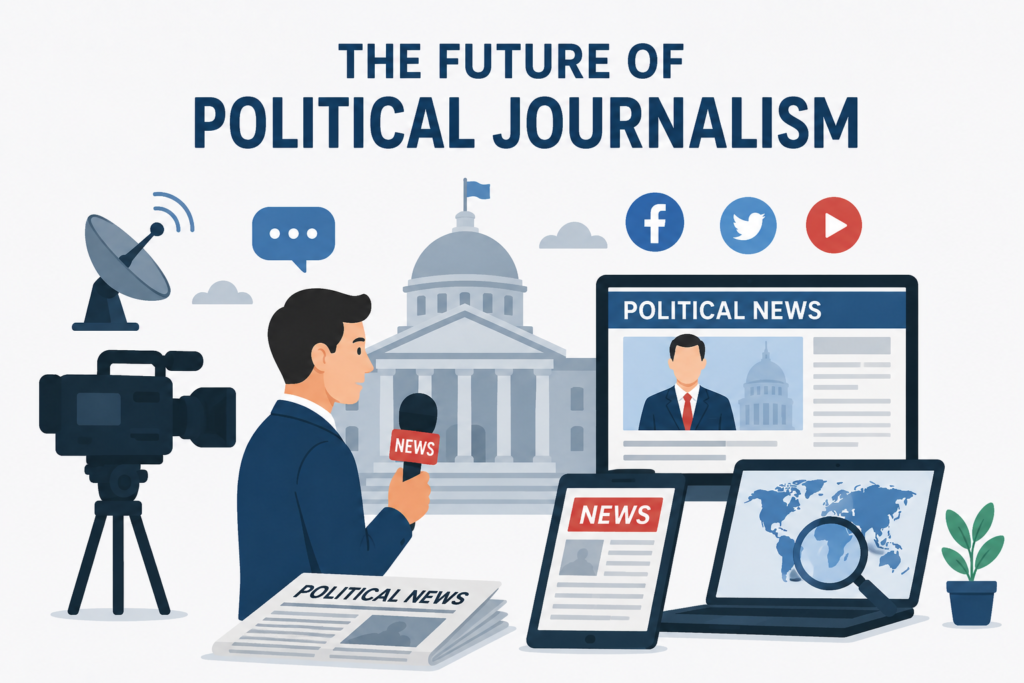
The future of political journalism probably mashes up those old-school reporting values with new high-tech tools. AI can help with research, transcribing interviews, and analyzing data, but seasoned reporters will still bring context, verification and critical thinking to the fold.
Political reporters will write about international cooperation, cybersecurity, climate policy, migration and global economic issues as societies become more globally interconnected. Additionally, international collaborations between investigators may see a rise.
With audiences becoming more aware to identify credible sources amidst misinformation and lack of factual reporting – Media literacy will be an increasingly valuable commodity. Credible, transparent and accurate news organisations will continue to be important cornerstones of democratic societies.
Conclusion
Political journalism is still, in some ways, the most important kind of reporting because it connects citizens to the political decisions that affect their lives. Political journalism enables transparency, accountability and an informed public through credible reporting, original research and well-balanced analysis. Sure, journalists have to deal with the difficulties of false news, political pressure and economic insecurity but their purpose continues unchanged — to provide citizens with credible information. Ultimately, the health of political journalism rests on finding this balance as technology advances; that is, adhering to ethical standards while innovatively and responsibly adapting to innovations under 2023 and beyond while also preserving independent journalism’s credibility with the public.


